1936
Alan Turing
1912–1954
The Universal Machine
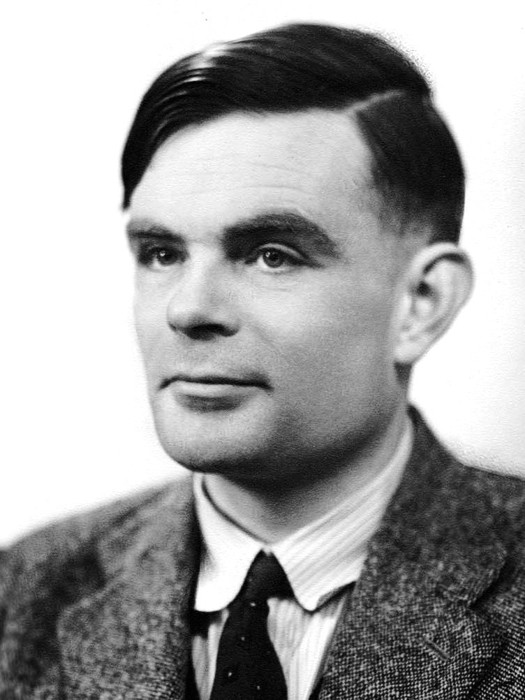
Defined computation itself, broke wartime ciphers, and in 1950 asked 'Can machines think?' — proposing the Imitation Game now known as the Turing Test.
His 1936 paper 'On Computable Numbers' imagined a simple machine reading and writing symbols on a tape, and proved a single universal machine could perform any computation.
At Bletchley Park he helped break the Enigma code. His 1950 paper 'Computing Machinery and Intelligence' replaced the question 'can machines think?' with a practical test of conversation, and foresaw machines that learn like children.
Dated contributions
1936
The Universal Machine
Alan Turing
Defined computation itself, broke wartime ciphers, and in 1950 asked 'Can machines think?' — proposing the Imitation Game now known as the Turing Test.
Paper · 1936 — On Computable Numbers, with an Application to the Entscheidungsproblem ↗1950
The Imitation Game
Alan Turing
Turing reframes machine intelligence through conversation and discusses learning machines.
Paper · 1950 — Computing Machinery and Intelligence ↗
Reference
Original work & historical records
- 1936 · Paper — On Computable Numbers, with an Application to the Entscheidungsproblem ↗
- 1950 · Paper — Computing Machinery and Intelligence ↗